Malanthropomorphism
2026-10-23Jack Dorsey's Dessa is the latest in a series of technological innovations that I lump into the category of malanthropomorphism.
There are many fine arguments why producing technologies like this is a pragmatic wrong. Scroll through the quote tweets of the announcement post and you'll find, among the expressions of incredulity and general fanboyism, plenty of people pointing out that this technology will be used for fraud and supplantation of human relationships. They are correct, certainly and almost necessarily: Dorsey's claim[1] that "[t]alking with it feels like talking with a person…full of emotion, nuance, pauses, and a natural cadence" implies it's intended to deceive either willing or unwilling participants. This is the main bad thing about it.
However, I think there's something else misguided about the whole project of synthetic human voice generation[2], which is that it is an attempt to make new technologies (machine intelligence, communication thereof) masquerade as old ones (human intelligence, speech). This is an instance of a more general -morphism: Jony Ive's greatest opp.
Skeuomorphism is all well and good in certain contexts. Personally, I am often charmed by app/web interfaces that attempt to replicate affordances of the past, and I've even dabbled myself. The classic example of the computer trash can was a pedagogically sound way to introduce the concept. But skeuomorphism has no place in replacing humans, because the promise of a skeuomorph is to transfer our understanding of the familiar to the unfamiliar, importing the benefits of the latter without the costs of the former. To be more specific: there is no knowledge to be gained about how the machine works by emulating human interaction, and plenty of opportunity for confusion and frustration.[3]
I was radicalized on this point by a call to a doctor's office earlier this year. The practice was acquired at some point in the last year by a mega-practice (backed by private equity firm LNK Partners--no comment), and reaching them by phone has become an undertaking. As I discovered this summer trying to refill a prescription, the latest innovation implemented is a new automated phone tree. This is not itself noteworthy, of course. In fact the original office may have had one, and I probably would've been a normal amount of irritated by the indignities of modern life had my ears not pricked at the background noise, which was the faked, looping hum of a bustling call center. I also noticed, after the call had been picked up but before my robolocutor joined the line, a tinny clip of an also-faked phone ring. As anyone who has waited on hold knows, the switch from elevator music to ringing is a promising sign that you are about to get the attention of a human being, who, almost without exception in my experience, is a saint condemned to work in a hellish bureaucracy and would very much like to help you.
What was the point of this charade? In my cynic's heart, I believe it was designed to lull me into the sense that the call would be answered by a person, maybe one with a lot on their plate, and thereby prime me to be a patient patient. (Certainly this backfired.)[4] A more charitable explanation is that the intention was to communicate to me that while, yes, this was the scary new experience of talking to a machine, it was just like that familiar and beloved experience of navigating a human-staffed call center. But a) everyone knows what it's like to talk to a machine at this point, and b) neither experience is beloved! I don't even learn anything else about how to interact with the machine to get what I want out of it. The use of skeuomorphs is both unnecessary and (granted, mildly) inconvenient, because I needed to wait for something that could've happened instantly.
Ok, so Dessa (the project here, not the entity) wants me to speak to the machine like I would speak to a friend. What do I get out of that skeuomorphic deal, if we suppose I'm not being explicitly tricked? A conversation with "err"s, small talk, faked laughter? I like hemming and hawing when I talk to a human; it's evidence we're thinking together. Similarly for small talk, and I'm not above polite chuckling (as recipient or donor). But the conviviality is the point. With a machine, it's a waste of time--mine and, to a lesser degree, its. Because it is up to something when it creates these pauses. I'm just getting no insight into it.
Jury's out for me--I think listening to a recording is very different from interacting directly, in terms of perceiving verisimilitude. Also tbh, I wasn't actually all that blown away by the demos. ↩︎
I don't have a good word for this distinction, but I'd like to note that I think of text-to-voice for accessibility purposes very differently. I can see a case for emulating mannerisms there, but that's not what Dorsey is up to. ↩︎
This article by Ryan C. Cordell helped crystallize the purpose and perils of skeuomorphism for me. He also makes the following astute point which I am cribbing here: that the text chat interface itself, which we take for granted at this point, uses a metaphor (texting, DMs, etc.) to "'conceal' the tool’s operation from users" (double quote because he is himself quoting Claude--read the post for more fun). ↩︎
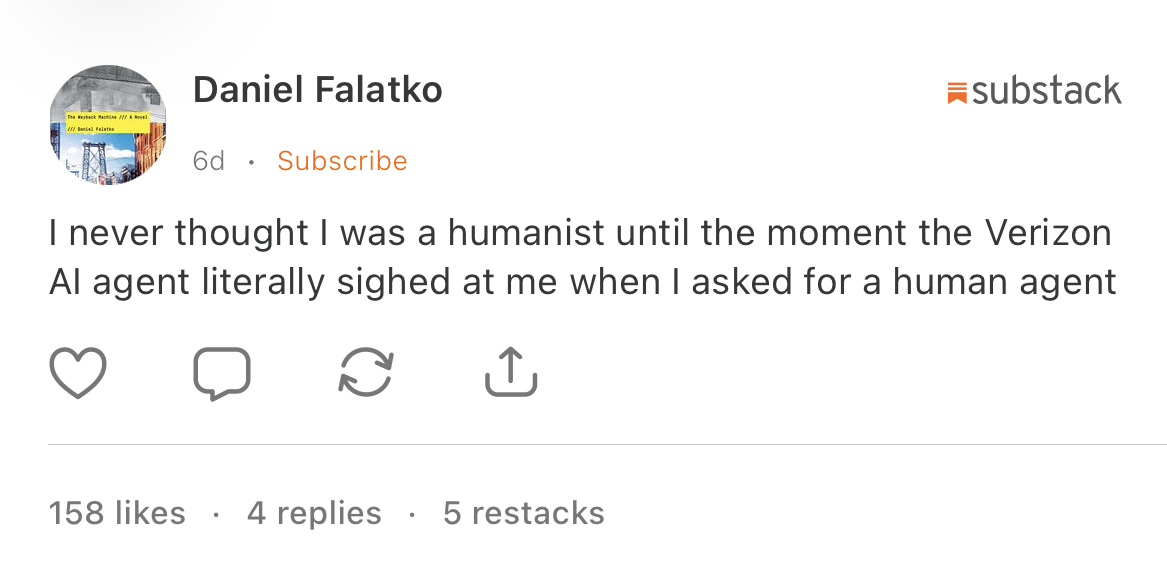
Evidently and unsurprisingly I am not the only person peeved.
 ↩︎